[Case 01]
Enhancing Food Delivery Checkout for Faster, Smoother Orders
Food Delivery
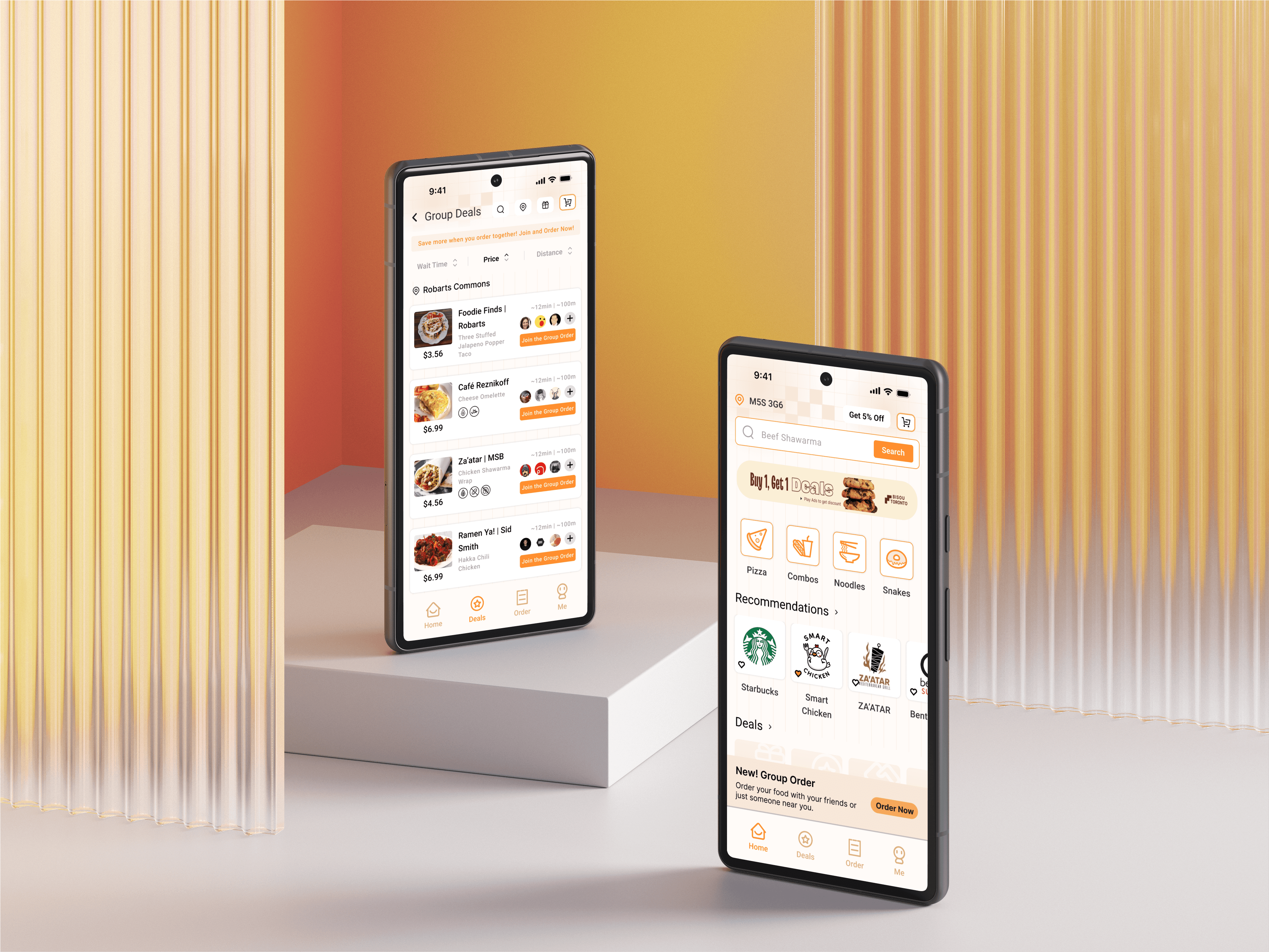
Inclusive Campus Dining for Every Student
Reducing Wait Times and Supporting Dietary & Cultural Needs
[Project Overview]
Many UofT students struggle with food accessibility, especially those with dietary restrictions or cultural preferences. Through 8 interviews and 112 surveys, we uncovered key pain points: lack of allergen clarity, long wait times, and no centralized way to pre-order.
[Problem Statement]
People with dietary restrictions often struggle to find safe and suitable dining options. Current platforms fail to clearly support allergy labeling, customized filters, or easy access to discounts. This leads to frustration, extra effort in meal planning, and missed opportunities for inclusive dining experiences.
[Industry]
Food Delivery
[My Role]
UX Designer
[Platforms]
Mobile
[Timeline]
January 2024- April 2024
[Process]
[01] User Research
Conducted in-depth interviews with 15 participants to uncover pain points and expectations during checkout.
Analyzed user journey data to identify drop-off points and friction areas.
Reviewed competitor flows to highlight best practices for conversion optimization.
[02] Insights
Users were frustrated by unclear error messages and repetitive form fields.
Mobile users struggled with small tap targets and unresponsive layouts.
Users needed trust in payment and personal data, but current flows lacked reassurance.
[03 Design Solution]
Streamlined checkout flow into three clear steps: Cart → Shipping → Payment.
Added autofill suggestions and real-time validation to reduce input errors.
Enhanced mobile experience with larger buttons, responsive layouts, and simplified UI.
[04] Testing & Iteration
Conducted A/B testing with 49 users comparing original vs. redesigned flows.
Gathered feedback from usability testing and refined based on input.
Delivered a mobile-first layout with larger touch targets and simplified navigation.
[Outcome]
Improved checkout flow clarity.
Reduced friction during mobile transactions.
Higher confidence and smoother experience, confirmed through class usability testing.
[Key Learnings]
Simplicity matters
Removing unnecessary steps improved overall usability and made the flow more intuitive.
Testing is essential
Even small usability tests revealed hidden pain points and validated design decisions.
Attention to details
Micro-interactions like real-time error validation had a noticeable impact on user confidence.